






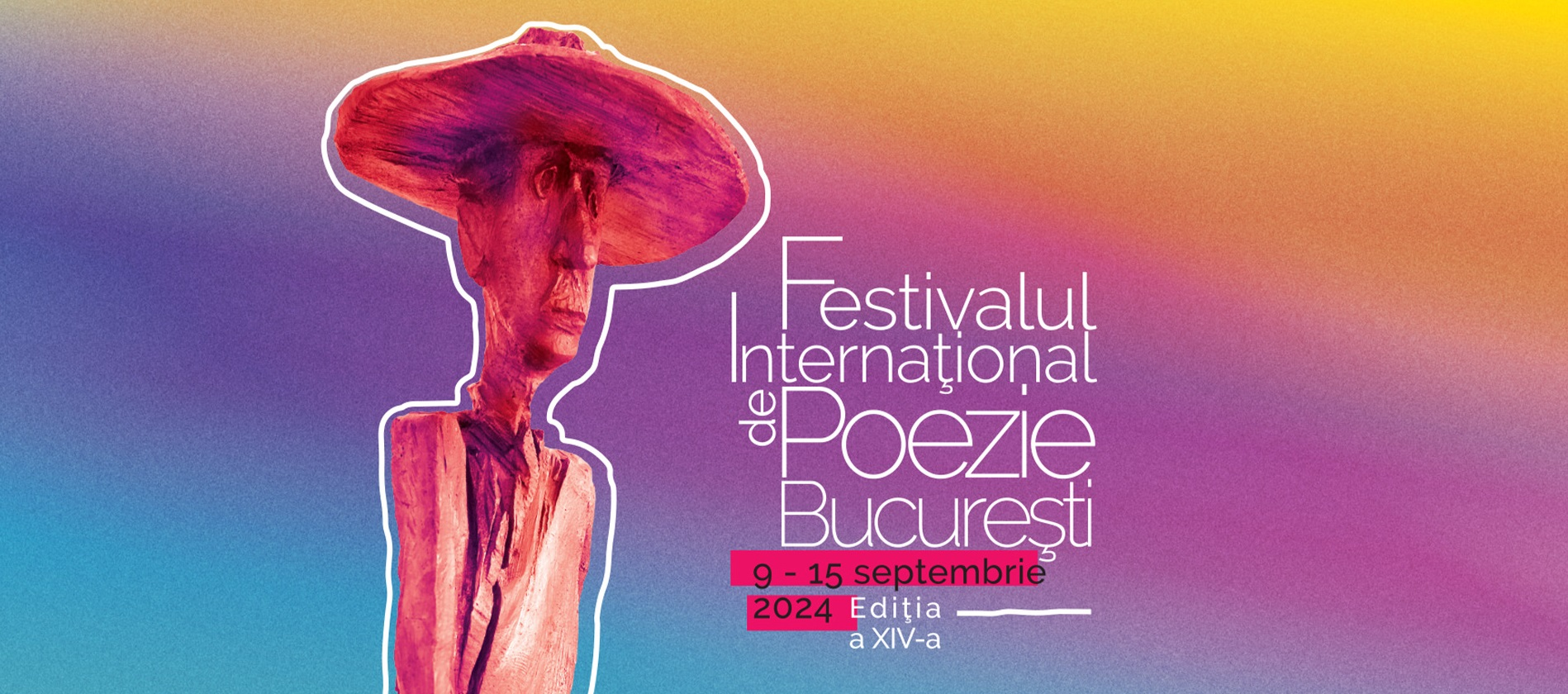
Chris Tănăsescu was invited – at my recommendation – by the organisers of the XIVth International Poetry Festival Bucharest, The National Museum of Romanian Literature, to perform a very special sort of poetry, The #GraphPoem. A way of discovering the poeticity of oneself & the world in the very recent age of deep interaction between laptop wizardry, music, words and the timbre of the voice that deserves to be explored, felt and though about. I asked him to write about it. See also how his performance impacted me at this link: https://www.fitralit.ro/30-09-2024-getting-under-the-skin-the-graphpoem/ (Peter Sragher)
The Graph Poem project took off at San Diego State U in 2010 where I conceived of it as the most suitable theoretical framework and hands-on method for teaching and practicing creative writing, on the one hand, and for studying poetry in/and communities (my research topic as a Fulbright Scholar and Visiting Professor at the time).
From that initial formulation—summarized and briefly illustrated on Jerome Rothenberg’s Poems and Poetics (http://poemsandpoetics.blogspot.com/2011/03/chris-tanasescu-graph-poem-four-poems.html), and developed into the bilingual collection Nomadosofia / Nomadosophy (https://www.asymptotejournal.com/criticism/margentos-nomadosofianomadosophy/)—the project quickly and inevitably morphed into a poetry-&-maths-and-computer-science research program (or, with a term that later on caught up and I was not aware of at the time, digital humanities or DH). As an academic research program, the Graph Poem has been awarded, funded and/or hosted at and endorsed by universities, research institutes, and funding agencies in the US, Asia, Canada, and western Europe. Roughly speaking, the research involved deploying natural language processing (NLP) and graph-theory applications in automatically analyzing stylistic features across large poetry corpora. As a first poet-beneficiary of those computational analyses and outputs, I illustrated their potential utility myself by way of my own analytical-creative approaches (https://journals.openedition.org/recherchestravaux/4900) to poetry composition as multimodal and networked/communal/participatory computational assembling (https://journal.dhbenelux.org/journal/issues/002/article-39-tanasescu/article-39-tanasescu.html).
Drawing and expanding on precedents spanning the first decade of the 2000s (e.g., https://www.youtube.com/watch?v=DpJDupSbH68) and the early 2010s (e.g., https://emergencyindex.com/projects/2012/038-039), the research project naturally spilled into performance.
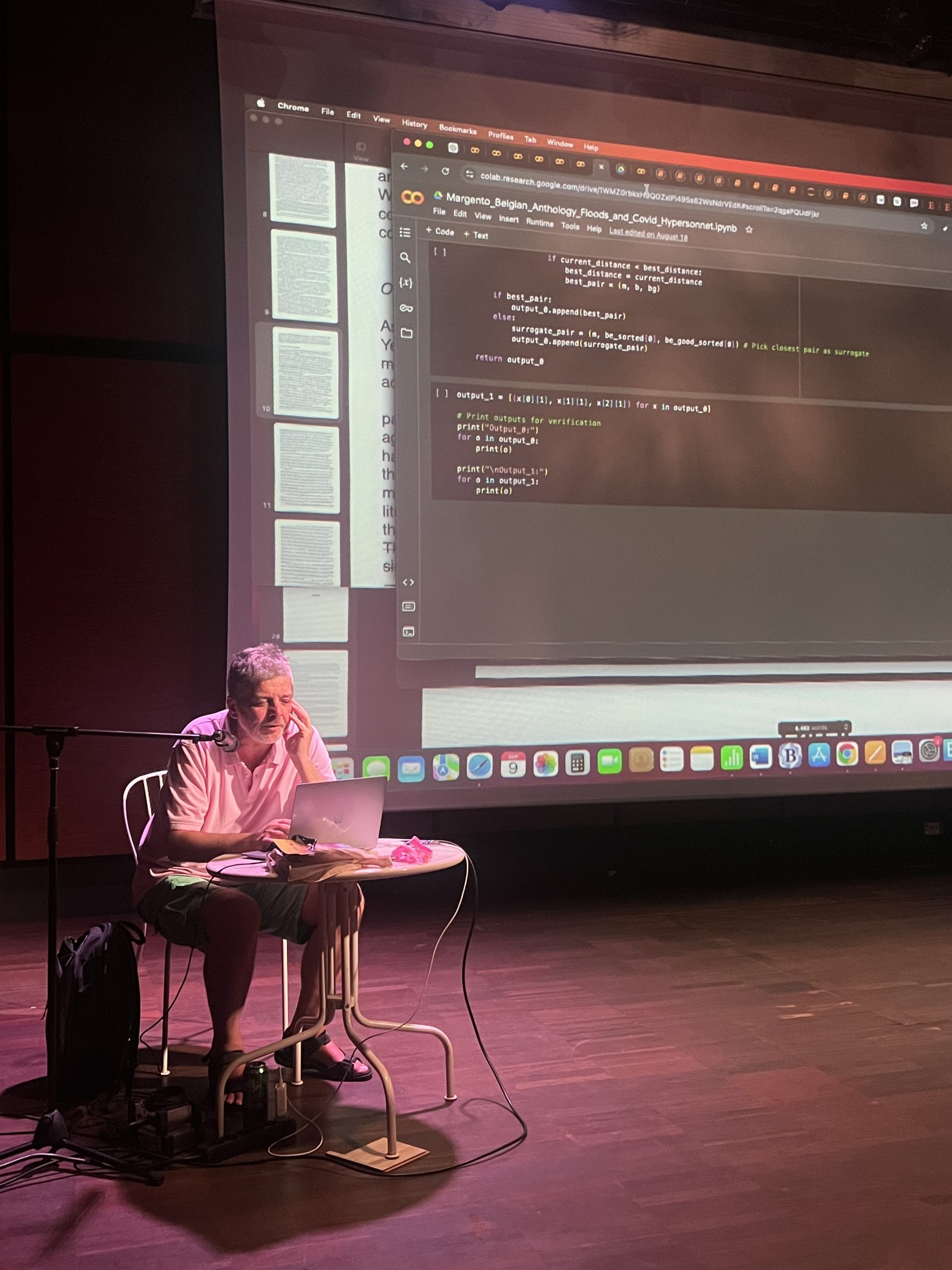
The #GraphPoem events presented at Digital Humanities Summer Institute (DHSI, https://dhsi.org/aligned-events-2024/) for instance—annually since 2019—and elsewhere (e.g., the CROWD Omnibus Tour from the Arctic Circle to the Mediterranean, 2016, https://crowd-literature.eu/one-is-a-crowd-margento/) interoperationally combine a number of platforms, including JupyterHub, Twitter, Facebook, and GitHub into collective data assembling or “data commoning,” and web-based coding performances—“webformances”—into a specific and most ample type of intermediality: interplatform intermediality, or “interplatformity.” (https://www.taylorfrancis.com/books/edit/10.4324/9781003320838/literature-computation-chris-tanasescu?refId=99a40198-83cc-4fb5-ba9f-d5cb90b08f33&context=ubx)
Participants in such events are given access to a JupyterHub repo where they can contribute files live to a data folder and/or run a Python script analyzing those data. The latter are thus represented as an evolving network that is analyzed for topological features and the consequently significant nodes (files in the dataset) are sampled by a Twitter bot, @GraphPoem. This whole process is fed into a Facebook livestream (@Margento.official) that can be watched by anybody anywhere online or on site.
The poetics informing such events has mainly gravitated to network walks and intermediality (https://ideah.pubpub.org/pub/tgdpsell) as well as dynamical systems deployed in studying and triggering poetry-and/as-community networks in/as performance. (https://www.taylorfrancis.com/chapters/edit/10.4324/9781003320838-3/dynamical-systems-interplatform-intermediality-chris-tanasescu?context=ubx&refId=e9afd31a-ca60-4b11-80b2-b51e3c1a0910)
In the specific case of #GraphPoem @ BIPF/FIPB 2024, large-language-models (LLMs) and deep learning were deployed and/or programmed in algorithmically shaping up an improvisational and emergence-based performance computationally and intermedially linking, on the one hand, the development of in-progress poems and poetry collections, and, on the other, the showcasing or clashing of unreleased Margento text-visual-and-sonic works and other vectorially charted and sampled music and soundscape datasets.


