





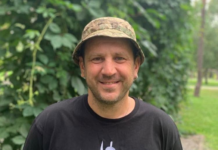
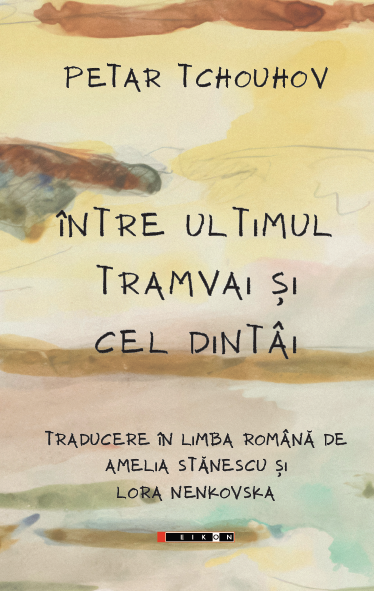

The poetry collection signed by Petar Tchouchov, Între ultimul tramvai și cel dintâi tramvai (Between the Last Tram and the First One), translation into Romanian by Amelia Stănescu and Lora Nenkovska, Eikon Publishing House, Bucharest, 2026 will be presented very soon, at Bookfest – The International Book Fair Bookfest, Bucharest, 3-7 June 2026. We invited him to share with us some thoughts on poetry and not only. You can read some of his poems in Bulgarian and the Romanian translation here: https://www.fitralit.ro/29-05-2026-petar-tchouhov-любовта-е-зад-ъгъла-dragostea-e-dupa-colt/
Peter Sragher: When did your write your first poem?
Petar Tchouhov: I wrote it when I was a third grade student at school. It was cynical, full of obscene words, but with good rhymes and the older boys in the neighborhood would cheer me on and make me recite it every now and then, so I was happy to get that much attention and decided I was going to be a poet.
P. S.: Did you have a teacher at the gymnasium or a professor at the university that fostered your passion for poetry or was it somebody in the family?
P. Tch.: Actually, it was my father who ignited the sparkle of poetry in me. He used to write poems to amuse me, based on the stories from the children’s magazine PIF which was available in Bulgaria during the sixties, but just in French, it’s original language. He didn’t speak French, so he invented his poems just looking at the pictures, but these stories in rhymes were really interesting and convincing, I mean they went very well with the pictures. And after a while, trying to copy him, I started creating my own rhyming stories. I did it also at school, writing humorous poems about my classmates and that made me somewhat popular.
P. S.: When did your passion for haiku start and how?
P. Tch.: 1985 was the year when the first book of haiku was published in Bulgaria: an anthology of Japanese haiku Full Moon. It was my first contact with this exquisit poetic form and I was really fascinated. I immediately started writing three-line poems, but at first they had nothing to do with haiku. It took me a long time to get acquained with the true haiku spirit – after reading a lot of poems and articles in English, because for a long time there was almost nothing about this fixed form of poetry in Bulgarian. What’s interesting, as a result of this, for many years I wrote haiku almost exclusively in English. Now, I still do it from time to time.
The English language ist the most natural for the genuine rock
P. S.: Music & the guitar are essential for you. How did you discover this passion for music and how does it match your need for poetry?
P. Tch.: As most children, I started liking music when I was a small child. In the beginning, it was sort of indiscriminate passion—I could listen to and enjoy almost all genres and style of music. But when I grew up a little—I remember I was in the third grade—I discovered rock music (it was about 1970) and it was like a revelation to me. I felt that in this music there was so much freedom. Also the English language, which, in my opinion, is the most natural for the genuine rock—I didn’t understand a single word, but in sounded to me so different, so cool. There was an acoustic guitar at our villa and every time we went there, I would strum it quite chaotically and sing along, trying to copy what I had heard on Yugoslav radio stations, which had rock shows, unlike the Bulgarian ones. Step by step I started learning chords and taking classical guitar lessons, so after a while I was able to compose my own songs to which I often would add some lyrics (during this time I had already started writing poems). I felt that music could add more strength and power to poetry, but also poetry could make music more profound and meaningful.
P.S.: Poetry Death Match. You told me about this way of presenting poetry to the audience and making it more popular, transforming it into and original contest. You organised several such… letal matches in Bulgaria.
P.Tch.: The idea for poetry duels came to me through football. Football players are in the spotlight all the time—not only on the pitch, but also before or after the matches. They are interviewed all the time, although they rarely have anything different to say. I wanted poets to be a little more
The idea for poetry duels came to me through football
visible too. So I decided that when there is a competition, people get more excited, they become more empathetic. In my poetry duels, the audience decides who wins by voting. This way, the spectators are more engaged, they pay more attention, and more people come. This format has proven to be successful and I have continued it for more than twenty years. Recently, at the Sofia Library, where I work, I have been organizing a poetry championship for Sofia schools. It is currently in its fourth edition.
P. S.: I invited you the first time to Romania, I think, in 2008 (2010 I think) at the International Poetry Festival in Galați-on-the-Danube. I asked Lora Nenkovska whom I could invite to a festival and she gave me three names. I don’t think that I chose you to take part in this cultural event because we share the same surname…
P. Tch.: Yes, we share the same first name and we are almost the same age also. But I’m tempted to believe that the real reason was something a bit mystical, the feeling of some poetic kinship, which was there despite the fact that we had never met before, nor were we familiar with each other’s work. It’s no coincidence that we have been friends for more than fifteen years since then, I think.
P. S.: You met many Romanian poets, some also in Bulgaria or abroad at poetry festivals. What do you think about the contemporary Romanian poetry?
P. Tch.: This is a really difficult question, because although I personally know quite a few Romanian poets and have read quite a few others, I do not have the credentials of a literary critic, and it is difficult for me to systematize my observations. But generally, I can say that contemporary Romanian poetry seems very diverse to me, with authors writing at a high level. I would only name two poets that I like, one, alas, is already deceased, I hope the other is alive and well—Ioan Es. Pop and Horia Bădescu. So different from each other, but very close to my soul and, in my opinion, endowed with a very high poetic energy.
Two poets from Romania I like – Ioan Es. Pop and Horia Bădescu
P. S.: In a few days you are going to present your brand new poetry collection at The International Book Fair Bookfest in Romania your poetry collection, Между последния трамвай и първия / Între ultimul tramvai și cel dintâi. Amelia Stănescu did the literary translation. How did she decide to translate your poetry into Romanian?
P. Tch.: I met Amelia in 2010 at a haiku festival in Pécs, Hungary. At that time, she didn’t speak English and I didn’t speak French and Italian, the languages she is proficient in, so we weren’t able to comunicate efficiently. During the years until 2013 we met two or three times again at festivals or events and, again, we weren’t able to really communicate. But eleven years later—2024—we met at the festival Poezia—Port La Dunăre (Poetry—A Harbour to the Danube) in Galați and I realized that her English was much improved (shame on me, the level of my French and Italian was just the same as before, i.e. zero). So, we talked a lot and I offered her my poetry collection in English and also in Bulgarian. After two or three weeks she wrote to me that she has started translating my poems (She told me that she did it because she liked my poems, not because we both had a glass or two when we were in Galați J). Then I put her in contact with Lora Nenkovska who is a prominent translator from and into Romanian. Lora started helping her in her endeavour.
P. S.: You are a beer lover. Which beer is better the Bulgarian Zagorka or the Romanian Ursus?
P. Tch: I personally like Ursus more, especially some interesting varieties like Ursus Nefiltrată, Ursus La Tank, Ursus Black Grizzly. Zagorka is generally more traditional, there are no different types just now, although there used to be some.
P. S.: A question the I did not ask and you would want to be asked here…
P.Tch: The question is: Are you happy with this interview?
And the answer is: Yes!
